
Morrish Homes launched the first net zero ready homes at Nansledan, the Duchy of Cornwall’s award-winning extension to Newquay. Designed to support the long-term vision of a greener and more sustainable community, the ambition for these two semi-detached houses was clear. The project needed to lower upfront embodied carbon, exceed current Building Regulations Part L, eliminate fossil fuels and integrate renewable technologies without compromising buildability or the strict construction programme. A central objective was to avoid traditional high-carbon construction methods and replace them with lower-impact alternatives.
Morrish Homes
LHC Design
Residential Development
Nansledan, Newquay, Cornwall
Bio Twin Wall Design and Manufacture, Hemp Insulation Supply and Installation, Revit Modelling, Window and Door Installation, Energy Assessing Services
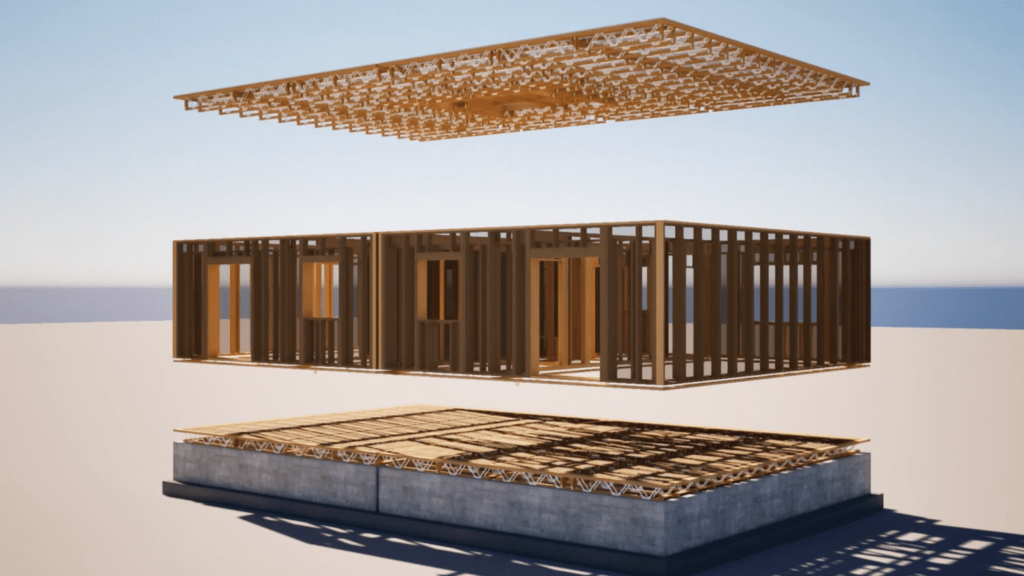
Sydenhams Timber Engineering provided a fully integrated timber frame solution manufactured and installed within a tightly managed 35-day programme. The entire scheme was modelled in Autodesk Revit to ensure absolute precision.
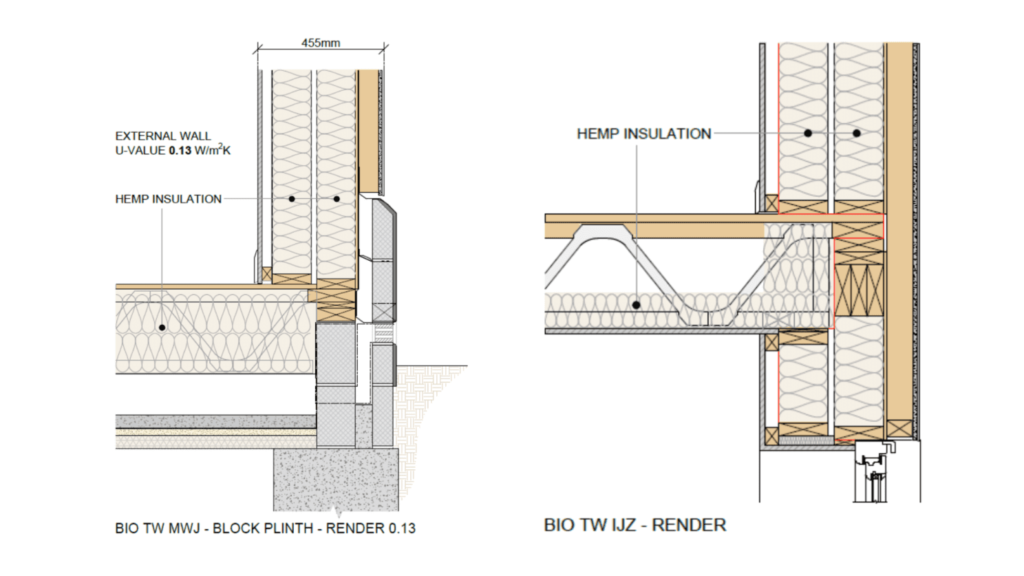
To minimise embodied carbon, the external envelope utilised our innovative Bio Twin Wall system alongside direct fix cladding and render on carrier board to remove the need for a masonry outer skin. A suspended timber ground floor replaced traditional beam and block construction to significantly reduce concrete use. The timber frame structure was insulated with UK-grown hemp supplied by the GRWN Group to support domestic supply chains and reduce transport emissions.
Our team handled the complete installation including airtightness membranes, airtight flooring from Medite Smartply, service battens, external doors and windows. Our in-house experts also provided comprehensive energy assessment services including SAP calculations, PHPP modelling, overheating risk analysis and rigorous airtightness testing.
The project successfully demonstrates that volume housebuilding can meaningfully reduce its carbon impact. The combined timber frame and insulation system sequesters approximately 30 tonnes of CO2e within the building fabric. The homes were built to exceed current Part L requirements and achieved passive house levels of airtightness at 0.6 ACH.
Operating entirely on low-carbon electricity with no gas connection, the homes feature an air source heat pump, a 4.98 kWp solar PV array and battery storage to provide approximately 70 percent annual energy self-sufficiency. The predicted Energy Performance Certificate rating is Band A, proving that passive house levels of performance and renewable technologies can be successfully delivered within a mainstream residential development context using the Bio Twin Wall system.